India's Darkest and Brightest Cities 2026: The Night Sky Report
We analysed a decade of NASA satellite data over 50 Indian cities. The median city's night sky is 70% brighter than in 2015, only six cities can still clearly see the Milky Way — and the fastest-growing light pollution in India is not in a metro. It is in Leh.
Key findings
- India's night skies brightened by a median of 70% between 2015 and 2025. 47 of the 50 cities we analysed are brighter than they were a decade ago.
- Leh has India's fastest-growing light pollution: +546% in ten years. The sky above the gateway to India's only Dark Sky Reserve is now 6.5× brighter than in 2015.
- Bengaluru has overtaken Delhi as India's brightest city sky (65.0 vs 57.5 nW/cm²·sr).
- Only 6 of 50 cities still have skies dark enough to clearly show the Milky Way (Manali, Darjeeling, Shimla, Ooty, Leh, Jaisalmer). 34 of 50 have Bortle 8–9 city skies where almost no stars are visible.
- Every one of India's classic dark-sky getaway towns is losing its darkness — Shimla +165%, Jaisalmer +151%, Manali +136%, Rishikesh +118%.
Data: NASA Black Marble VNP46A4 annual composites (2015, 2020, 2025), analysed by SkyQI. Free to republish with attribution and a link — see methodology below.
India's brightest city skies, 2025
| # | City | Radiance 2025 (nW/cm²·sr) | Sky class | Since 2015 |
|---|---|---|---|---|
| 1 | Bengaluru | 65.0 | Bortle 9 | -6% |
| 2 | Delhi | 57.5 | Bortle 9 | -3% |
| 3 | Hyderabad | 49.5 | Bortle 8 | -7% |
| 4 | Kolkata | 45.8 | Bortle 8 | +34% |
| 5 | Ahmedabad | 41.9 | Bortle 8 | +99% |
| 6 | Lucknow | 39.9 | Bortle 8 | +18% |
| 7 | Mumbai | 36.5 | Bortle 8 | +48% |
| 8 | Pune | 31.8 | Bortle 8 | +79% |
| 9 | Chennai | 31.7 | Bortle 8 | +61% |
| 10 | Jaipur | 30.5 | Bortle 8 | +48% |
The top of this table is not a surprise — it is every major metro. What is surprising is the ordering: Bengaluru's night sky is now measurably brighter than Delhi's, and the gap to the chasing pack is closing fast. Ahmedabad's sky has doubled in brightness since 2015 (+99%), the fastest growth of any top-10 metro.
A Bortle 8–9 sky means fewer than a few dozen stars are visible to the naked eye. Roughly 270 million people live in the ten cities above, under skies where the Milky Way has not been visible for a generation.
India's darkest city skies, 2025
| # | City | Radiance 2025 (nW/cm²·sr) | Sky class | Since 2015 |
|---|---|---|---|---|
| 1 | Manali | 0.35 | Bortle 1 | +136% |
| 2 | Darjeeling | 0.66 | Bortle 4 | +54% |
| 3 | Shimla | 1.61 | Bortle 4 | +165% |
| 4 | Ooty | 1.68 | Bortle 4 | +51% |
| 5 | Leh | 2.16 | Bortle 4 | +546% |
| 6 | Jaisalmer | 2.90 | Bortle 4 | +151% |
| 7 | Rishikesh | 4.14 | Bortle 5 | +118% |
| 8 | Panaji | 7.51 | Bortle 5 | +74% |
| 9 | Madurai | 8.25 | Bortle 5 | +54% |
| 10 | Thiruvananthapuram | 9.35 | Bortle 5 | +145% |
The good news: India still has genuinely dark accessible skies, and they are exactly where you would hope — Himalayan hill stations, the Thar desert, the Nilgiris. Manali has the darkest sky of any city we measured, dark enough (Bortle 1–2) for the Milky Way to cast shadows on a moonless night.
The bad news is the right-hand column of that table.
The decade India switched on
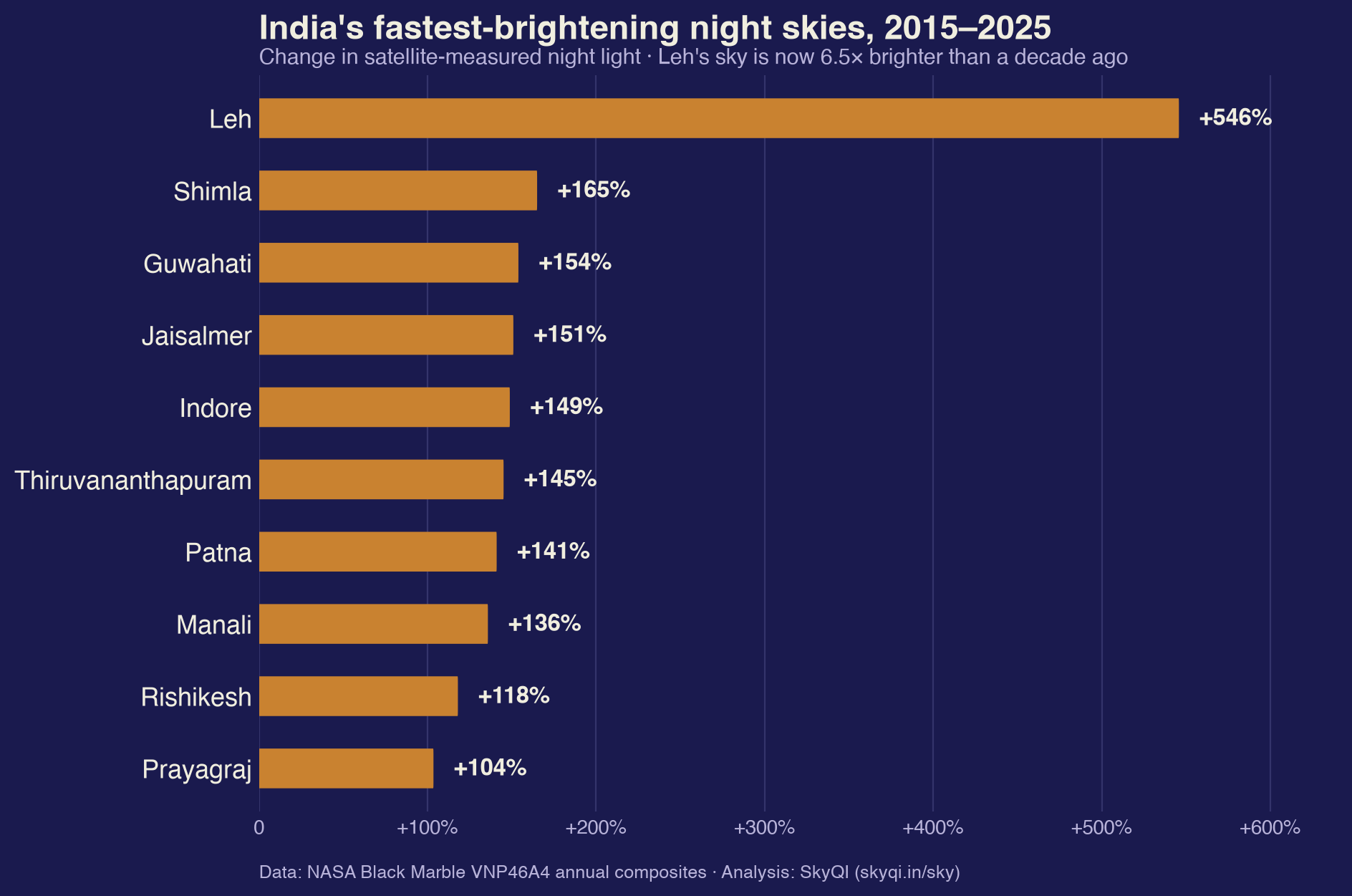
The fastest-growing light pollution in India is not in the metros — their skies are already saturated. It is in the small, beautiful places people escape to precisely because they are dark.
The Ladakh paradox
Leh's night sky brightened 546% in a decade — 6.5× — the fastest of all 50 cities we measured.
The irony is painful. Hanle, 250 km southeast of Leh, became India's first official Dark Sky Reserve in 2022. Astro-tourism boomed. Hotels, homestays, streetlights and headlights followed — and the sky above Leh, the gateway every stargazer passes through, is vanishing at the fastest rate in the country.
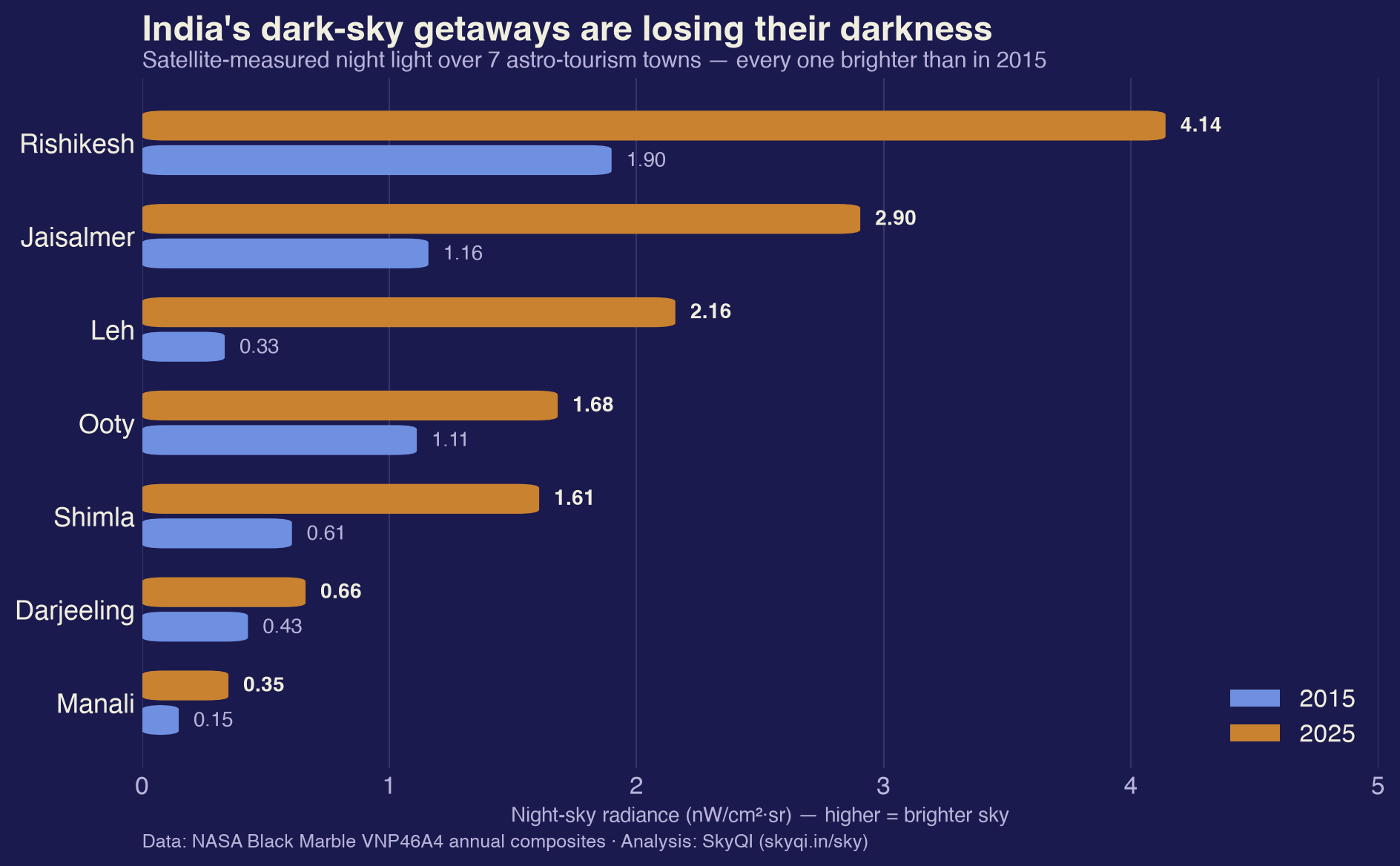
Leh is still a Bortle 4 sky — the Milky Way is clearly visible, and the truly pristine sky at Hanle is a short drive away. But at +546% per decade, the window is closing. The same pattern holds at every dark-sky destination in India: Shimla +165%, Jaisalmer +151%, Manali +136%, Rishikesh +118%, Ooty +51%, Darjeeling +54%.
Dark skies are becoming India's rarest natural resource — consumed by the tourism they attract.
The metro illusion
Three cities appear to have improved: Delhi (−3.4%), Bengaluru (−5.9%), Hyderabad (−7.2%).
Do not celebrate yet. These are the years of India's mass conversion from sodium-vapour streetlights to LEDs, and the VIIRS satellite sensor cannot see blue light — the very band where white LEDs emit most strongly. Ground studies worldwide show that cities "darkening" in satellite data during LED transitions often got worse for actual skyglow, because blue light scatters more in the atmosphere, not less.
The honest reading: metro skies plateaued in the satellite's band while their light shifted to wavelengths the satellite cannot measure. This is precisely why ground measurements matter — and why SkyQI exists. Satellites see cities from above; only people standing under the sky can measure what it actually looks like.
What this means
A median +70% in ten years is not gradual change — it is the extinction of the night sky as a shared experience, within a single generation. The 2026 Perseids peaked under a perfect new moon this week; in 34 of India's 50 largest cities, almost nobody could see them.
It is also an opportunity. Dark skies are now scarce enough to be valuable: Hanle's Dark Sky Reserve created a local astro-tourism economy precisely by protecting darkness. Ladakh, Spiti, the Thar and the Nilgiris hold an asset most of the world has already spent.
Check your own city on our city sky pages — current Bortle class, Milky Way visibility, and the nearest darker sky for 50 Indian cities. Then step outside on the next clear night and measure your actual sky with a phone photo. Every reading sharpens the map.
Methodology
- Source: NASA Black Marble VNP46A4 Collection 2 annual composites (Suomi-NPP satellite; Román et al. 2018, Remote Sensing of Environment 210), years 2015, 2020 and 2025 — the latest annual composite available. All three years from the same sensor and processing lineage, so decadal comparisons are like-for-like.
- Measure:
AllAngle_Composite_Snow_Freeradiance (nW/cm²·sr) at native 15-arcsec (~500 m) resolution, averaged over a ±0.1° box (~22 × 22 km) centred on each city. - Sky class: radiance converted to approximate SQM and Bortle class with the same calibration used across SkyQI's live map, so this report matches what you see there.
- Limitations: VIIRS is blind to blue light (see "The metro illusion"); satellite radiance measures light emitted upward, which correlates with — but understates — the skyglow an observer sees. City-box averages smooth over bright cores and dark outskirts.
- Reuse: the full dataset and this analysis are free to republish with attribution to SkyQI (skyqi.in) and a link. Media queries: sastrophy@gmail.com.
Appendix: all 50 cities, ranked brightest to darkest
Radiance in nW/cm²·sr. Click any city for its full sky profile.
| Rank | City | 2015 | 2020 | 2025 | Change | Class |
|---|---|---|---|---|---|---|
| 1 | Bengaluru | 69.10 | 65.63 | 65.00 | -6% | B9 |
| 2 | Delhi | 59.49 | 47.12 | 57.48 | -3% | B9 |
| 3 | Hyderabad | 53.31 | 42.67 | 49.50 | -7% | B8 |
| 4 | Kolkata | 34.28 | 37.71 | 45.85 | +34% | B8 |
| 5 | Ahmedabad | 21.07 | 26.95 | 41.94 | +99% | B8 |
| 6 | Lucknow | 33.76 | 34.61 | 39.85 | +18% | B8 |
| 7 | Mumbai | 24.61 | 27.05 | 36.54 | +48% | B8 |
| 8 | Pune | 17.77 | 23.19 | 31.79 | +79% | B8 |
| 9 | Chennai | 19.68 | 22.60 | 31.73 | +61% | B8 |
| 10 | Jaipur | 20.62 | 23.00 | 30.54 | +48% | B8 |
| 11 | Indore | 12.07 | 16.74 | 30.02 | +149% | B8 |
| 12 | Prayagraj | 13.31 | 12.05 | 27.08 | +104% | B8 |
| 13 | Vadodara | 13.54 | 16.98 | 25.29 | +87% | B8 |
| 14 | Chandigarh | 14.48 | 15.91 | 24.66 | +70% | B8 |
| 15 | Surat | 12.94 | 16.54 | 23.74 | +83% | B8 |
| 16 | Kanpur | 16.37 | 18.97 | 22.77 | +39% | B8 |
| 17 | Patna | 8.93 | 15.63 | 21.53 | +141% | B8 |
| 18 | Nagpur | 15.13 | 12.45 | 20.16 | +33% | B8 |
| 19 | Bhopal | 11.04 | 12.95 | 20.16 | +82% | B8 |
| 20 | Jodhpur | 15.40 | 16.41 | 19.71 | +28% | B8 |
| 21 | Varanasi | 9.79 | 11.24 | 19.25 | +97% | B8 |
| 22 | Ludhiana | 10.36 | 11.48 | 17.81 | +72% | B8 |
| 23 | Agra | 14.47 | 12.49 | 17.68 | +22% | B8 |
| 24 | Bhubaneswar | 9.53 | 9.22 | 17.66 | +85% | B8 |
| 25 | Raipur | 10.01 | 11.32 | 17.24 | +72% | B8 |
| 26 | Visakhapatnam | 11.66 | 11.71 | 15.54 | +33% | B8 |
| 27 | Ranchi | 9.62 | 11.19 | 15.13 | +57% | B8 |
| 28 | Nashik | 9.52 | 10.39 | 14.20 | +49% | B8 |
| 29 | Coimbatore | 8.12 | 9.99 | 13.48 | +66% | B8 |
| 30 | Gwalior | 8.26 | 10.26 | 13.34 | +62% | B8 |
| 31 | Amritsar | 7.94 | 9.84 | 13.34 | +68% | B8 |
| 32 | Dehradun | 6.71 | 7.73 | 13.03 | +94% | B8 |
| 33 | Mysuru | 10.45 | 12.09 | 12.34 | +18% | B8 |
| 34 | Guwahati | 4.79 | 4.96 | 12.16 | +154% | B8 |
| 35 | Jabalpur | 7.48 | 8.92 | 11.78 | +57% | B7 |
| 36 | Kochi | 5.60 | 6.72 | 11.31 | +102% | B7 |
| 37 | Kota | 8.50 | 7.39 | 11.02 | +30% | B7 |
| 38 | Udaipur | 5.91 | 6.26 | 9.98 | +69% | B5 |
| 39 | Vijayawada | 5.26 | 6.48 | 9.74 | +85% | B5 |
| 40 | Srinagar | 5.24 | 6.42 | 9.67 | +85% | B5 |
| 41 | Thiruvananthapuram | 3.81 | 5.81 | 9.35 | +145% | B5 |
| 42 | Madurai | 5.36 | 5.59 | 8.25 | +54% | B5 |
| 43 | Panaji | 4.33 | 4.57 | 7.51 | +74% | B5 |
| 44 | Rishikesh | 1.90 | 2.23 | 4.14 | +118% | B5 |
| 45 | Jaisalmer | 1.16 | 1.61 | 2.90 | +151% | B4 |
| 46 | Leh | 0.33 | 0.69 | 2.16 | +546% | B4 |
| 47 | Ooty | 1.11 | 0.82 | 1.68 | +51% | B4 |
| 48 | Shimla | 0.61 | 0.81 | 1.61 | +165% | B4 |
| 49 | Darjeeling | 0.43 | 0.26 | 0.66 | +54% | B4 |
| 50 | Manali | 0.15 | 0.11 | 0.35 | +136% | B1 |
Download the report and the data
- Full report (PDF) — all 50 cities, charts and methodology
- Report as a web page — the same findings, linkable section by section
- Data as CSV — 50 cities × 2015/2020/2025 radiance, decadal change, SQM and Bortle
- Data as JSON — same fields, with units and provenance
For journalists and researchers
This report is free to republish, in whole or in part, with attribution to SkyQI and a link back to this page (CC BY 4.0). The underlying data is open — please use it, check it, and tell us if you find an error.
The per-city numbers are the story in most places: every one of these 50 cities has its own page with current Bortle class, Milky Way visibility and the nearest dark sky — for example Leh, which brightened faster than anywhere else in India, or Bengaluru, which has overtaken Delhi as the country's brightest city sky.
Method in one line: mean night-time radiance from NASA's Black Marble VNP46A4 annual composites (2015, 2020, 2025) over a ±0.1° box — roughly 22 × 22 km — centred on each city. One important caveat is stated plainly in the report: VIIRS is blind to blue-rich LED light, so the three metros that appear to have dimmed have almost certainly not.
For interviews, the raw grids, or a city not on this list: sastrophy@gmail.com.
SkyQI is a citizen-science platform that turns any smartphone into a sky quality meter. Photograph the night sky, get an instant SQM and Bortle measurement, and join the map: iOS · Android.